Galapagos Islands 11th
February to 4 March 2015
The sail from Panama to the Galapagos was going to involve a
lot of motoring as we were crossing the equator and sailing through the Doldrums.
It was 900 miles and on board were John, Catherine, Sarah and Chris.
Leaving Panama
The rally was due to leave from the Las Perlas Islands off
Panama on 11 February. We were all acutely aware that we had to prepare the
boats to be allowed access into the Galapagos islands which included removing
all slime and barnacles from the boat. Our original plan was for Andy and Emma
from Pentagram to do this but events conspired against us – we had to return to
Panama City to get our generator fixed and then both Andy and Emma were ill
just before the start and while they valiantly tried to clean the hull, they
could not spend enough time on it.
So we employed a professional diver and left six hours after
the rest of the boats and just as it was getting dark. We started with good
winds as we got into the Gulf of Panama which rapidly rose to 40 knots + with
gusts of up to 55 knots. This was Chris’s first real sail with us since he
joined us in Panama - in the dark with a big sea behind us and sailing between
islands either side and shipping coming to and from the Canal. What an
introduction to ocean cruising that was!
With the help of Sarah and Chris we managed to reef the boat
and get it under control but not before we took a few waves that knocked us
sideways with the consequence that the wind got in front of the genoa and
ripped out some of the rivets holding the genoa pole to the mast. Nothing we
could do except put away the pole and not use it – effectively it meant that we
could not sail downwind directly and had to be at least 30 degrees off the
wind, one side or the other.
By morning the winds had calmed down and we settled into
sailing the 900 miles to the Galapagos. At least for the first 24 hours because
that was as long as the wind lasted and we were then three days motoring in
breathless conditions but helped by a strong current.
We crossed the equator with a celebratory drink of champagne with a toast to Neptune.
 |
| Crossing the Equator |
We finally managed to sail for the last couple of days into
the wind coming off the port bow for about 36 hours until we got to the top of
San Cristobel and we were faced with 28 miles of beating directly into the wind and against the current. Sod
that, we decided we would motor so as to get there and get through the
formalities quicker!
We had been well
briefed on what to expect and we radioed in as we approached San Cristobel so
that the officials could come and meet us. The first thing was the three divers
who spent 15 minutes inspecting the hull to ensure it was clean. An hour later
the 7 officials came on board to inspect the boat, what we had on board and how
we managed the boat e.g. rubbish etc. we filled out separate forms for each of
the officials, much with the same information on and we showed them round the
boat while they opened cupboards, inspected the fridge and all our stores. The
only thing that came out of this was that a mango was confiscated, being
wrapped up in tape with the words “dangerous item” printed on it. Otherwise we
got a clean bill of health. Whew, what a relief.
San Cristobel 18
march - March
The first thing that struck us about San Cristobel was the
sheer number of sea lions. They were on the back of boats, on the quayside, on
the beach and hundreds of them. We were advised not to use our dinghies for
that reason and to make sure that we did not give them the opportunity to get
on the boats. They can be difficult to dislodge and are not house trained! In
the harbour there is a fleet of water taxis that ferry people to and from the
yachts anchored in the harbour and it was a very good service.
The town itself is very small with minimal shopping
facilities other than basic food stuff. Fortunately we did not need much.
We took a taxi ride around the island the next morning and
by 2pm we had pretty much seen all the major sites on the island:
- A tree house that was enormous that some over
indulgent parent had built for their kids about 50 years ago, complete with a
fireman’s pole and a basement beneath the tree.
It really was quite spectacular and a popular place for tourists.
- A walk around the highest lake on the island
which gave us the opportunity to do some hiking and see the birds using the
fresh water lake to clean themselves. As it was high up and to the windward
side of the island, it rained while we walked around which was very refreshing,
if not slightly damp!
- The tortoise breeding centre where they breed
the giant tortoises before

letting them back into the wild. This was a 2 mile
trail up a mountain where you saw nothing until about 100 years from the exit
where all the giant tortoises hang out. Mainly because that is where they put
the food and water for them. If we had known this, we could have walked around
the breeding centre in the reverse direction and saved the two mile walk.
The highlight was the trip to Kicker Rock which was a 45
minute fast boat ride (fast and wet with the spray) and then a swim through the
gap in the rocks which lasted about an hour. We saw plenty of fish and reef
sharks in clear water as the current drifted us through the rocks. Another boat
had seen some hammerhead sharks the other side of the rock and they took us
back around so that we could see them. It makes you realise how big these
sharks are when they are swimming 5 metres under you. Fortunately they are well
fed in the Galapagos because of the abundance of marine life so we were not on the
menu.
Andy from Pentagram came over to our boat to look at the
genoa pole track armed with a rivet gun and 20 years experience of dealing with
metal. It took us two hours to straighten the track and re-rivet the pole back
in place – something that I expected to be a lot more difficult. That night,
Chris prepared a BBQ and Andy and Emma joined us for what was a splendid meal
on board as a way of saying thank you for fixing the pole. And as ever when we
meet up with Andy and Emma we had a good few drinks!
Isobella
Our favourite island although to get to the town required a
water taxi from the boat (a very poor service and expensive), and a 1.5 km walk
along a hot dusty road under construction. The town was something like I
imagined in a wild west town to be with wide dirt roads and one main street.
There were a few restaurants and bars and a few shops, mainly offering tourist
visits.
The first day we took a water taxi the price was $1 which
was the same as San Cristobel.. The trip back became two dollars and in the
evening they charged everyone $5 and we had no option but to use them. The next
day and thereafter we used the dinghy and took the risk that we would find a
sea lion in it when we returned. We also decided to take the short cut across
the reef which we could do if the sun was behind us or it was night time and we
could use a torch to spot the coral heads. We could only do this if it was at
least half time but it saved about 10 minutes and a long trip around the reef.
The second day we decided that we would walk up to the Wall
of Tears, a wall that had been built by convicts while it was a penal colony as
late as the 1960s. It was a brutal regime and the prisoners were made to build
a wall that was totally pointless – and in the heat of the equatorial sun.
Eventually it was closed down but not before many convicts died in the process.
We left the boat at 10:00 in the morning and in typical
English style chose the heat of the day to walk the 8 Km up the hill to the
wall. It was a very long, hot and tiring walk and there was no-where to get any
water at the top. Seeing the wall was a little disappointing after spending 3
hours getting there but it was good to have a long walk. The walk back was at
least downhill and we stopped to have our picnic on route. We stopped at one of
the beaches and while Sarah and Catherine went for a swim, Chris and I laid on
some benches and had a good sleep. Sarah and Catherine took the opportunity to
eat some cake on the beach which we had bought for afternoon tea, only to be
told off by one of the wardens since consuming food in the national park was
not allowed. Not sure how they expect people to walk all that way and back
without something to eat!
The following day, Chris and I had arranged to walk up to
the top of the Volcano which involved getting to the dinghy dock by 8:00 ready
to be picked up and driven to the base of the Volcano. We joined a group of 20
people, some of whom spoke English and the rest Spanish. You have to have a
guide and the tour was in supposed to be in English. As he seemed reluctant to
actually speak to anyone it might have well been in Spanish. We had a two hour
walk up to the top crater (the second largest in the world) and then on a
further hour to set of barren rocks which had stunning views over the island.
Meanwhile Sarah and Catherine stayed on the boat before
heading into town. Sarah had gone for a snorkel from the back of the boat the
100m to the reef only to be told that she must have a guide to do so – several
times! Not sure what value the guide would add other than providing employment
for a guide.

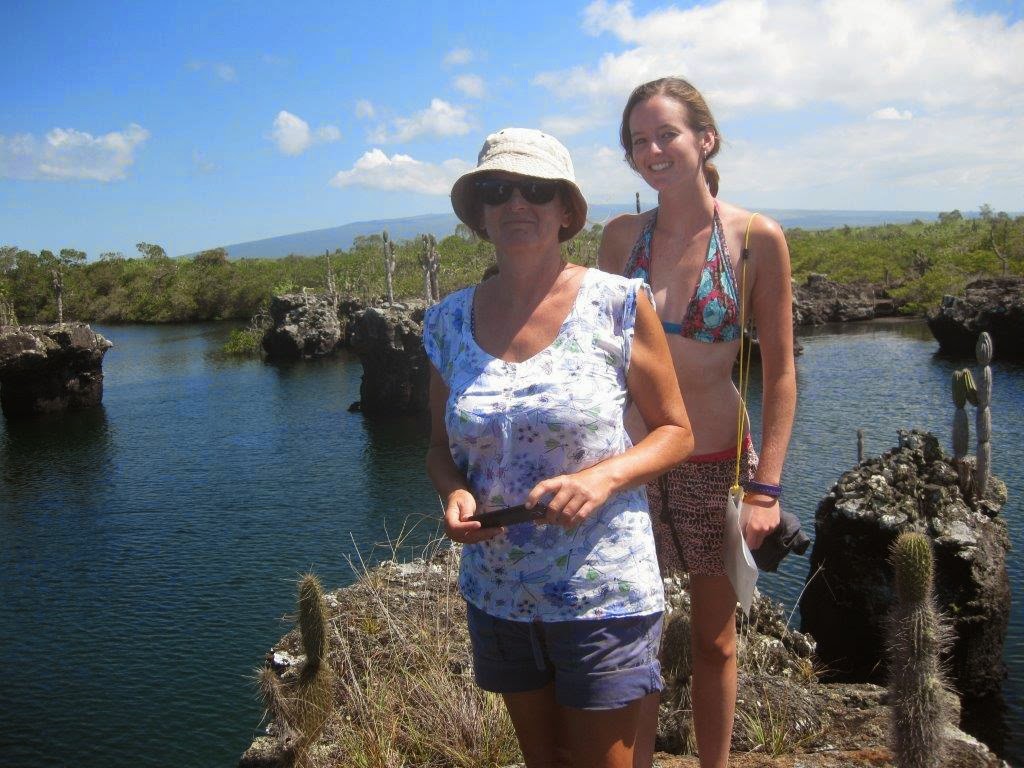
Our final trip was to the lava tunnels which entailed a one
hour fast boat ride along the coast and then snaking through a series of reefs
to get into the heart of the lava tunnels. The tunnels were produced by gas
within the lava which created bridges over the water ways. Quite spectacular as
were the penguins that live there. Smaller than traditional penguins but they
are an odd site in such a warm place.
We were taken snorkelling to see some of the wild life. The
sea horse was very suspicious – it was fixed around a plant growing up from the
rocks in about 5m of water and there were no other sea horses around. It was
suspicious because we were taken straight to the place where it was and it did
not move at all. However the sharks we saw were real and swam around us as was
the giant turtle which as 1.5m long by 1m wide and happily munched on the sea
bed while we dived down around it.
While we were in Isobella, we adopted The Booby as our place
of choice to drink. It was run by an American with a Galapagos wife who had
passable wifi and provided a very friendly service. We passed many an afternoon
with Pentagram (Emma and Andy) plus an assortment of crews from other boats
drinking and chatting the afternoon and evening away.
Santa Cruz
We had to be in Santa Cruz for 28th February when
Martin was once again joining us. Victor joined us for the 40 miles trip to
Santa Cruz to get back to Wayward Wind which he had joined as crew. They had
missed out Isobella and gone straight to Santa Cruz and Victor had jumped on a
ferry to get to the island. He spent three night in a hammock on the beach as
it was cheaper than staying in a hotel.
 |
| Bailing out the water |
On the trip across to Santa Cruz, I picked up one of the
floor boards to check the bilges to find that we had 2 feet of water in the
boat. A little bit of a shock to say the least and I found out that the bilge
pump was not working either. We closed off all the sea cocks and could not find
the source of the leak. So we set about with buckets and pint glasses to empty
the bilge which took about an hour until it was a reasonable level having taken
out 60 gallons of water by hand. I then managed to fix the bilge pump and we
cleaned out the rest of the water.
The leak was traced to a gasket on the fridge sea water
cooling pump which was a small but steady stream of water. I could not believe
that it could have created so much water in the bilge but once we switched it
off no more water appeared. Chris and I had checked the bilges while at anchor
not four days earlier so that it must have happened during that time. It was a
few days later until I was convinced that this was the sole source of the leak
but we had no more trouble once we sorted this out. Just another job to add to
the list of jobs before we were to leave Santa Cruz for the 3000 mile trip
across the Pacific in 4 days time!
We met up with Martin on the 28th in the local
bar as arranged. Sarah decided to move off the boat into a hostel for her final
two days to allow Martin to move into her cabin which was very nice of her.
Catherine also joined her in the hotel to have a few days away from the boat
and I suspect away from Chris, me and the endless list of jobs to be done.
Preparation for the
Pacific
Martin’s bag was a little heavy when we met him. He had very
kindly agreed to bring any spares out from the UK with him since they are
difficult to get out here. While there were quite a few packages delivered to
his house, they were mainly small and light weight – until the final order. I
had decided that the generator needed a new collector ring and bearings which I
ordered from the UK as an urgent request, 4 days before Martin was due to fly.
The order had to go through to the headoffice in Brussels and they could only
supply a complete replacement unit and not the individual components in the
time frame. And it had to be expedited by courier to the UK.
Apart from the cost of all this, it weighed 12.5kg which is
hardly hand luggage. I had taken a little gamble that this was the part needing
replacement and so the cost and the effort of getting it out to us seemed
excessive at the time. However it turned out to be the best thing I have done
for long while.
With all the spares that Martin had brought, it meant that
we could now get on with the jobs on the boat.
Martin and Chris both worked solidly through the list with a few hours
off in the afternoon.
We also had to get all the food, water, fuel and gas sorted
out for our trip, the food being the most time consuming and difficult. Several
trips to markets and supermarkets were undertaken mainly by Martin and
Catherine while Chris and I carried on the repairs on the boat.
Shopping takes on a whole new importance when you are
shopping for 4 people for 3-4 weeks at sea knowing that anything you have
forgotten or not bought enough of is just tough. And food is a very important
part of life on board as it is one of the key ingredients in maintaining morale
on a long journey so not something you want to get wrong.
Fixing the Generator
Chris and I had spent three days trying to get the fan off
the generator so that we could replace the Collector and bearings – it was the
first job after taking off the casing which itself was difficult because of the
working space in the engine room. We had
tried to clean the Collector which we could see was pitted and not much copper
left on it but it was too far gone and so we started to take the generator
apart. After three days it was clear that no amount of heating, hitting and pulling
was going to shift the fan and Andy from Pentagram offered to come and help. At
1:30 on the day before we were due to leave, Andy came over and tried and
failed to remove the fan which made me feel better in one way but it still gave
us the problem of how to get it off.
Andy decided that the only way this was going to work was to
replace the whole of the unit which meant dismantling the core of the
generator. Given the time and the fact we were leaving the next day I was more
than a little nervous about stripping it down but Andy was confident. Two hours
later and a lot of effort and heavy lifting we extracted the generator itself
from the engine compartment. It was bloody heavy!!! We also found that not only
had the Collector gone but the bearings were also on their last legs and so
replacing the whole unit was the only viable option. Fortunately I had bought a
complete unit so we could repair it.
Taking out the whole generator unit allowed us better access
to getting the fan off (it is only plastic held around a metal centre pushed on
a tapered shaft). No amount of heating, bashing or pulling would move it and so
we had to drill out the side of the taper. Two hours later and more bashing and
pulling and we got off the fan intact.
It took a further two hours to reassemble the generator with more heavy
lifting, careful alignment and rewiring before we could test it. And it worked
first time!
It took a further hour the next morning to clear up the boat
from all the effort with the generator and we still had to get the final
shopping, sort out the weather forecast etc.
But we were ready on time although a little tired!


 We had organised a tour of the island the next day with a
local guide, Pifa, who was also the local fireman and sea rescue. After 15Km,
the road stopped, just after the only roundabout on the island, and we were on
dirt tracks for the next 6 hours. Dirt tracks that were very uneven, full of
potholes making for not the most comfortable car journeys. However, Pifa was an
excellent guide, taking us to the ancient sites where the original tribes
lived, explaining the meaning of the Tikis (stone statues) and the local
rituals. This included how they eat people, some captured during wars with
other tribes and others that were voluntary – it was an honour to be eaten by
the chief and so people volunteered.
We had organised a tour of the island the next day with a
local guide, Pifa, who was also the local fireman and sea rescue. After 15Km,
the road stopped, just after the only roundabout on the island, and we were on
dirt tracks for the next 6 hours. Dirt tracks that were very uneven, full of
potholes making for not the most comfortable car journeys. However, Pifa was an
excellent guide, taking us to the ancient sites where the original tribes
lived, explaining the meaning of the Tikis (stone statues) and the local
rituals. This included how they eat people, some captured during wars with
other tribes and others that were voluntary – it was an honour to be eaten by
the chief and so people volunteered.

 The people live very simply and part of their
culture is that they all plant fruit trees in their gardens, so fruit is in
abundance. Hospitality is also part of their culture so despite the fact they
are relatively poor (no electricity, very few cars, living in simple houses
with little furniture) we were overwhelmed with their hospitality and
generosity.
The people live very simply and part of their
culture is that they all plant fruit trees in their gardens, so fruit is in
abundance. Hospitality is also part of their culture so despite the fact they
are relatively poor (no electricity, very few cars, living in simple houses
with little furniture) we were overwhelmed with their hospitality and
generosity.